Six Things We Got Wrong Building a Multi-Niche Newsletter Stack (And How We Fixed Them)

We could write a post about how brilliantly we executed this. We are not going to. Here are the six most expensive mistakes we made building a six-niche newsletter and content operation — what went wrong, what the fix was, and what we would tell anyone starting something similar today.
Mistake 1: Launching Before the Content Existed
What went wrong: We stood up the infrastructure, configured the tools, and launched subscriber sign-up pages before we had a content archive. The "coming soon" page was live for weeks while we wrote the first batch of posts. Almost no one signed up.
The fix: We wrote 6–8 posts per niche before opening any niche to subscribers. The subscriber pages stayed closed until there was something to actually subscribe to.
The lesson: No audience signs up for a promise. They sign up for a sample. Launch with enough published content that a new visitor can spend 15 minutes reading and decide whether your voice is worth a weekly email.
Mistake 2: Automating Before the Manual Process Was Proven
What went wrong: We built the n8n subscriber pipeline before we had validated the manual subscriber journey. The automation had edge cases we didn't know about because we had never walked through the flow ourselves as a subscriber.
The fix: For every automation we built after that, we first did it manually five times. If the manual version broke or produced weird results, we fixed the logic before writing a single automation node.
The lesson: Automation multiplies whatever is underneath it. Automate a broken process and you get a reliably broken process that is much harder to debug.
"Do things that don't scale. The habit of doing things manually first forces you to understand the process deeply enough to actually automate it correctly."
— Paul Graham, Co-founder, Y Combinator (2013, "Do Things That Don't Scale")
Mistake 3: Underestimating the Cost of Email Deliverability Setup
What went wrong: We assumed that setting up an SMTP relay and configuring DKIM would handle deliverability. It does not. Deliverability requires a warm-up period for new sending domains, bounce handling, unsubscribe compliance, and active list hygiene. We sent our first batch with a cold domain and roughly 40% landed in spam.
The fix: We implemented bounce handling (Listmonk blocks senders after 2 bounces), added double opt-in confirmation, enabled individual tracking, and used a subdomain warming sequence before any bulk sends. We also configured Mautic's unsubscribe handling and ensured CAN-SPAM compliance in every template.
The lesson: Email deliverability is infrastructure, not configuration. It requires ongoing attention, not a one-time setup. Budget time for it.
Mistake 4: Choosing Topics by Gut Instead of Signal Data
What went wrong: Early editorial decisions were made by asking "what do we feel like writing about?" Some of those posts performed well. Most did not because they answered questions no one was actually searching for or discussing.
The fix: We built the content signal scanner — an automated pipeline that ingests Hacker News discussions, arXiv publications, and BLS data releases every four hours. Signal items are scored, briefs are generated, and the editorial decision is "does this brief serve our audience?" rather than "what should we write about?"
The lesson: Editorial judgment matters. Signal data is not a replacement for editorial judgment — it is fuel for it. The gut still picks the angle; the data tells you which conversations your audience is already having.
Mistake 5: Treating Every Niche as Identical
What went wrong: We built the first two niche sites with the same content frequency, the same email cadence, and the same keyword strategy. Finance readers and Work readers are not the same audience. They have different publishing format preferences, different read depth, and different commercial sensitivities.
The fix: We adjusted cadence and format by niche based on engagement data. Finance gets longer-form, data-heavy posts. Work gets shorter, more actionable pieces. The underlying distribution system is identical — the content strategy is audience-specific.
The lesson: Infrastructure can be generic; content cannot. The automation stack is the same across all six niches. The editorial voice, format, and cadence should reflect the specific audience each site serves.
Mistake 6: Skipping Legal and CAN-SPAM Setup
What went wrong: We went live without a privacy policy on the main site, without proper CAN-SPAM footers in email templates, and without a clear unsubscribe mechanism that met the 10-business-day requirement. This is not a hypothetical risk — regulators act on complaints, and spam traps actively penalise non-compliant senders.
The fix: Added privacy policy, terms of service, and cookie policy pages to the main site. Updated all Listmonk and Mautic templates with compliant unsubscribe links and physical address footer. Enabled automatic list suppression for unsubscribes.
The lesson: Compliance is not overhead — it is reputation protection. A single spam complaint to your sending provider can result in account suspension. Every month of non-compliance is a month of accumulated risk.
The Pattern
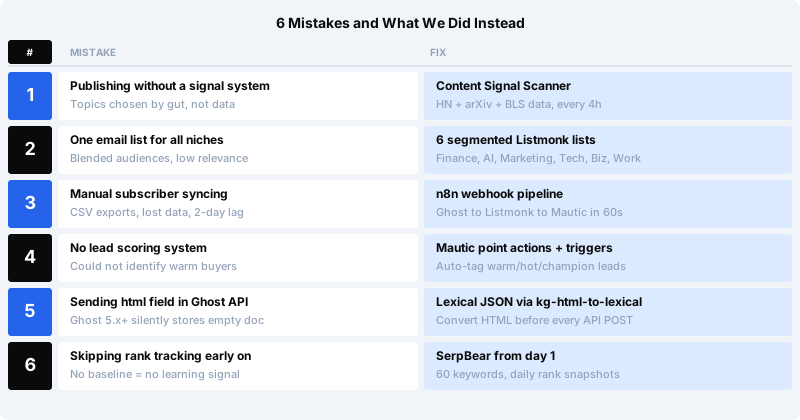
Every mistake on this list was a month of delay at minimum. The newsletter-led growth model rewards speed — not reckless speed, but the kind of forward momentum that only comes from publishing before everything is perfect and fixing what breaks. The firms that wait until the system is flawless before publishing never publish.
Publish now. Fix fast. The audience forgives iterative improvement. They do not forgive silence.