
What 60 Keywords Across 6 Niches Taught Us About B2B Content Strategy

When we set up SerpBear to track 60 keywords across six niche sites — 10 per niche — we thought we were setting up a rank monitoring tool. What we actually set up was a forcing function that sharpened every editorial decision we made for the next six months.
The 10-Keyword Framework
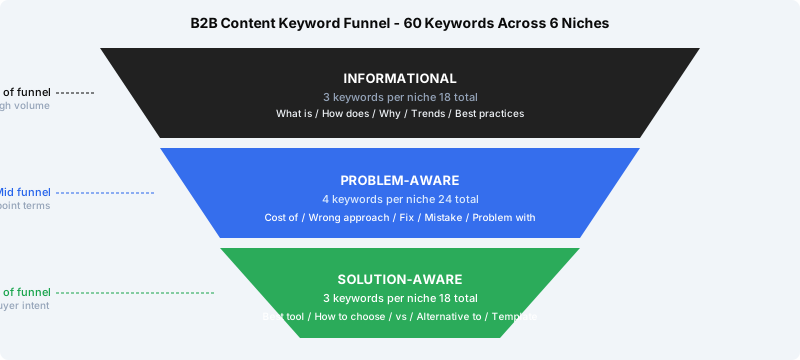
Ten keywords per niche is not arbitrary. It reflects how we think about the funnel for each audience:
- 3 informational (top of funnel): questions the audience is searching to understand a concept or trend. Low purchase intent, high volume. Example: "what is AI-powered CRM" or "how does newsletter monetisation work."
- 4 problem-aware (mid funnel): searches that indicate someone knows they have a problem but has not settled on a solution. Example: "b2b newsletter open rate declining" or "ai tool for content marketing teams."
- 3 solution-aware (bottom of funnel): searches that indicate someone is evaluating options. Lower volume, much higher commercial intent. Example: "best email automation for newsletters" or "b2b content strategy agency."
Most B2B content strategies over-index on informational content because it generates traffic, and under-index on solution-aware content because it is harder to write without sounding like a sales pitch. The data in our tracking changed that ratio for us.
What Happened When We Published Against Keywords vs. Gut Feel
When we published based on whatever felt interesting or timely, we got reasonable engagement from our existing subscribers but almost no organic search traffic. The content was good — our open rates said so — but search engines had no clear signal for what problem each post solved.
When we started writing against specific keyword clusters, two things happened. First, organic traffic to the posts increased significantly within 60–90 days. Second — and more importantly — the quality of the posts improved. A keyword cluster forces you to answer a specific question for a specific audience with a specific intent. That constraint makes you more useful, not less creative.
"The best content is not the most creative content — it is the most useful content for the right person at the right moment in their decision journey."
— Rand Fishkin, Co-founder, SparkToro (2022)
The Compound SEO Effect of Newsletters
Something we did not anticipate: newsletters build backlinks naturally when the content is genuinely useful. When we publish a long-form piece on B2B content strategy benchmarks and send it to 500 subscribers in the marketing niche, a meaningful percentage of those readers are themselves content professionals with blogs, newsletters, or social accounts. They cite us. They link back. They share.
This is the compounding flywheel that purely SEO-focused operations miss. You cannot manufacture this kind of backlink profile with link-building schemes. It comes from having a real audience who values the content enough to share it with their own audiences.
The B2B SEO Benchmark Picture
What We Learned by Niche
The six niches behave differently from a keyword perspective. Finance and AI have high search volumes but also high competition — ranking against established publishers requires highly specific angles rather than broad topic coverage. Marketing and Tech sit in a middle band where mid-funnel problem-aware content performs best. Biz and Work have lower competition overall, meaning new content ranks faster and backlinks carry more relative weight.
This is not a reason to treat every niche differently at the editorial level — the same framework applies across all six. But it does inform how aggressively we target high-competition keywords in different verticals, and how much we invest in link acquisition for each.
The Lesson
Keyword research is not the enemy of editorial quality. It is the map. You still have to make the journey interesting — the writing, the angle, the examples all have to be genuinely useful. But without the map, you are driving through territory hoping to find the destination. The map tells you which roads connect to where your audience is trying to go.
Every keyword we track is a signal about what our audience is struggling with. Sixty keywords across six niches is sixty conversations we can participate in before anyone has heard of us. That is what search is: a library of unanswered questions. Our job is to answer them better than anyone else.