How We Run 6 B2B Newsletters with a 2-Person Team

Running six niche B2B newsletters simultaneously sounds like a staffing problem. It is not — it is a systems problem, and systems are solvable. Here is how we do it with two people.
The Division of Labour
One of us owns content strategy: which topics to cover, what angle serves the audience, when to publish. The other owns infrastructure and automation: the pipelines that move content from draft to inbox, the tooling that handles distribution, and anything that touches code or servers.
This split is intentional. The moment one person tries to own both strategy and tooling, quality degrades in both directions. Strategy needs creative headspace; infrastructure needs precise attention. They are not compatible tasks when run inside a single focus window.
The Weekly Rhythm
Every publishing cycle follows the same spine:
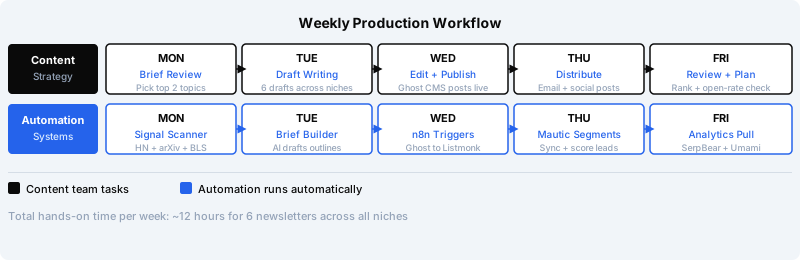
- Signal scan (automated, every 4 hours): Our content signal scanner pulls from Hacker News, arXiv, and BLS data releases. It scores items by composite relevance across all six niches and writes to a database table. No human reads these raw feeds.
- Brief review (Monday morning, ~30 minutes): The content strategist opens the brief queue, reads AI-generated summaries of the top signals, and approves or rejects briefs. Approved briefs fire a webhook that creates a Ghost draft in the relevant niche blog.
- Draft and edit (Tuesday–Wednesday): The content owner writes against the brief. The brief contains the target keyword cluster, a suggested angle, and three supporting data points. This halves research time.
- Publish and distribute (Thursday): Ghost publish triggers n8n, which adds the subscriber to the Listmonk list, queues the email send, and fires a social post via Postiz. The entire distribution chain runs without human intervention once the publish button is hit.
- Review (Friday, 15 minutes): Check open rates, click rates, and any deliverability flags. Log anything that broke. Adjust next week's signal scanner weights if a topic underperformed.
What Is Actually Automated vs. Manual
We are honest about this distinction because most "fully automated" content operations are lying. Here is the real split:
Automated: signal ingestion, brief generation, Ghost draft creation, email distribution, social scheduling, subscriber sync across tools, lead scoring in Mautic, CRM handoff in EspoCRM.
Manual: brief approval, actual writing, editorial judgment on angle and framing, any content that requires primary research or interviews.
The automation handles the logistics. The writing is still human. That is not a limitation — it is the product.
"The companies that win with content are not the ones that produce the most — they are the ones that are most consistent. Volume is a vanity metric; consistency is a trust metric."
— Ann Handley, Chief Content Officer, MarketingProfs (2023)
The Tool Chain
Ghost handles publishing across all six niche sites. n8n sits in the middle as the automation layer connecting everything. Listmonk manages email delivery. Mautic handles behavioral scoring and segmentation. EspoCRM receives the leads that have warmed past our scoring threshold. Dify powers the AI chatbot embedded on each site.
None of these tools are exotic. All of them are open source or self-hosted. The stack costs roughly $40/month in infrastructure, which means the entire operation is profitable with a very small number of engaged subscribers.
The Audience Numbers
The Insight That Drives Everything
Newsletter-led growth works because it forces you to earn attention before asking for anything. Every other growth channel — paid ads, cold outreach, SEO alone — involves asking the audience to take an action before they have any reason to trust you. A newsletter inverts this. You give first. You give consistently. You give for months before a single commercial ask.
By the time someone books a call with us, they have read our work twenty times. The trust is already built. The sales conversation is short because the relationship is long.
That is the model. It takes longer to start producing revenue than running ads. It is also significantly harder to kill once it works.